
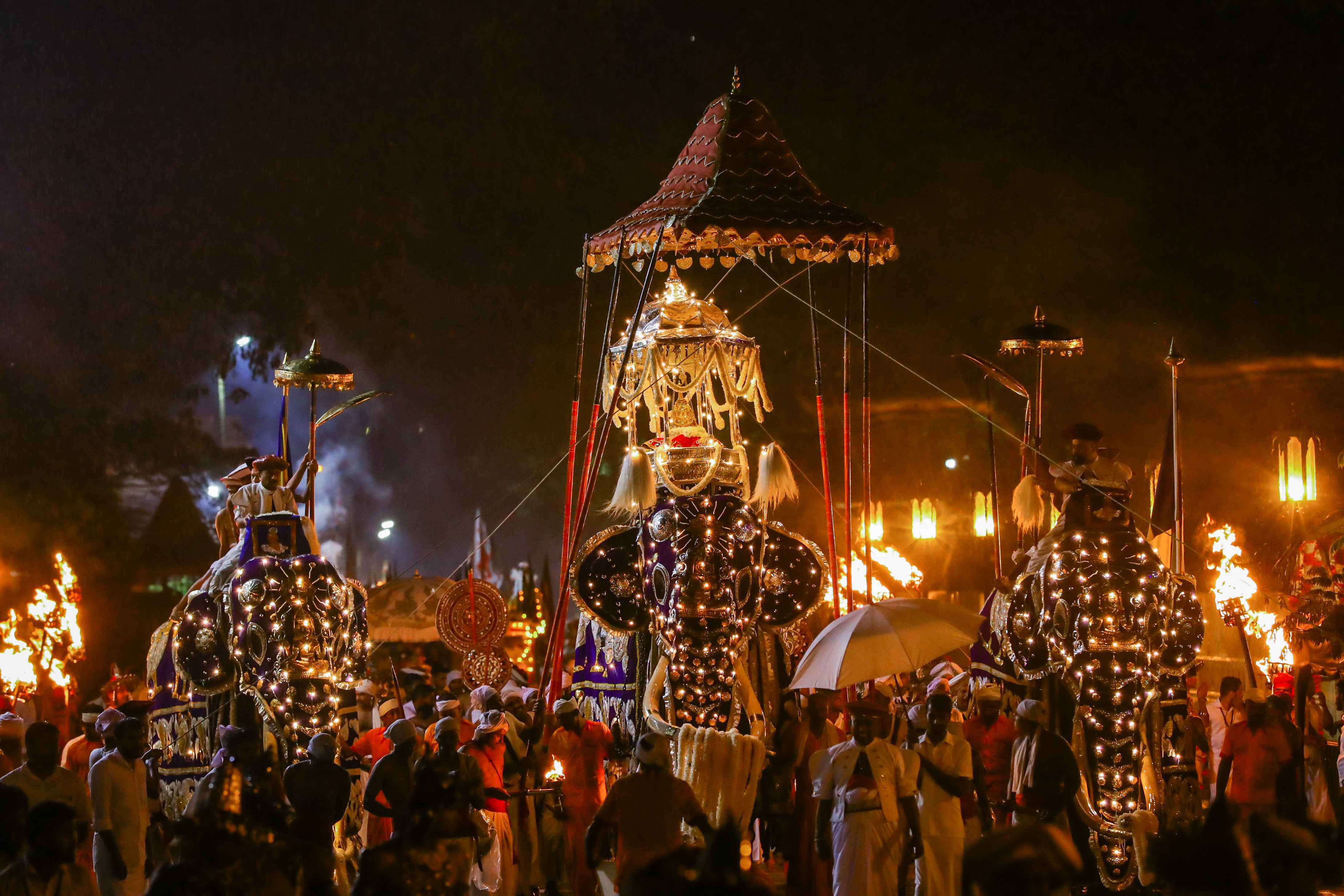
In the year 543 B.C., at the funeral pyre of the Lord Buddha at Kusinagar, a fragment of the left canine tooth was preserved by the disciple Khema. For nearly nine centuries it remained in India — in the kingdom of Kalinga, in the care of kings who understood that its custody was not an honour but a debt. In 310 A.D., in the reign of King Guhasiva, that debt was passed on. The relic was carried across the sea to Sri Lanka by Princess Hemamala and Prince Dantha, concealed in the princess’s hair.
They arrived at the reign of King Kithsirimewan in the ancient capital of Anuradhapura. From that day, the Tooth Relic has not been a private object of veneration. It has been a public one — a condition of rule. Whoever held the Dalada held the right to govern the island. Every subsequent kingdom — Anuradhapura, Polonnaruwa, Dambadeniya, Yapahuwa, Kurunegala, Gampola, Kotte, Seethawaka, and finally Kandy — carried it with them, and so the country’s political centre moved with the relic. The Perahera is, in that sense, a continuation by other means: a procession that once was a king’s, and is now a city’s.
What the relic is, and what it is not
To a devotee, the Tooth Relic is not a fragment. It is regarded and worshipped as the living Lord Buddha. The relic is never directly seen by the public — it rests inside seven nested golden caskets housed in the inner chamber of the Vadahitina Maligawa, the upper sanctuary of the Temple of the Sacred Tooth Relic. What is carried in procession during the Perahera is a replica casket, the Karanduva, upon the back of the Maligawa Tusker. The true relic remains in the temple.
This distinction matters. The Perahera is not a display of the relic. It is an act of paying homage to it — a procession walked in its honour, not with it. The relic itself has not left the temple since its last formal movement centuries ago.
The temple
The temple that now houses the Dalada was completed under King Vira Narendra Sinha in 1707 A.D., on the grounds of the old royal palace beside the lake at Kandy. The lake itself — Kiri Muhuda, the Sea of Milk — was dug under the last Sinhalese king, Sri Wickrama Rajasinha, in 1807. Palace, temple, and lake were conceived together as a single cosmological composition: the Buddha at the centre, the king circling, the city encircling them both.
The temple is administered by the Diyawadana Nilame — a lay custodian whose role predates the arrival of the British, survived the colonial period, and remains one of the most significant positions in contemporary Sri Lankan civil life. The Diyawadana Nilame is elected by a council of Buddhist laity and serves a renewable term. He is, in the week of the Perahera, the public face of the ceremony.
The Perahera as homage
The Esala Perahera begins every year on the day of the Kap Situweema — the installation of the consecrated Jak-tree post at the four Devalas of Kandy (Natha, Vishnu, Kataragama, and Pattini). For ten nights thereafter the procession walks. The first five — the Kumbal Peraheras — are modest, domestic in scale. The second five — the Randoli Peraheras — are grander, culminating in the Maha Randoli Perahera, the largest procession of the cycle. The morning after the Maha Randoli, the ceremony closes with the Diya Kepeema — the water-cutting — at the Mahaweli river.
The relic is the reason. The procession is the form. The ten nights are the pace at which the form is walked.
The Sacred Tooth Relic, which is housed at the Temple of the Sacred Tooth Relic in the city of Kandy, is being considered and worshipped as the living Lord Buddha.
Further reading in this Chronicle
- The Five Peraheras — the ten-night cycle, and what distinguishes one night from another.
- The Cast of the Procession — the tuskers, dancers, drummers, and officers who walk.
- Diya Kepeema — the water-cutting ceremony and the close of the Perahera.